IT Security Archives - Page 2 of 3 - DNA IT Solutions

Tag Archives: IT Security

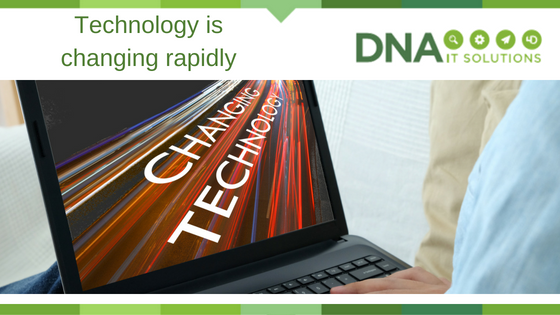
Technology is Changing Rapidly

Technology is changing rapidly DNA IT Solutions

A fine wine will improve with age, however, the same cannot be said about technology.  As your technology gets a bit older it will start to cause issues and that in turn will impact your business.

Open to attack

Old technology will be more prone to compromises.  Hackers have seen the old stuff before, so it is easy to cause some problems.  Your business then becomes an easy target and that is not what you want.

Would you drive a car without an NCT?  Would you trust one that has high mileage and had not been serviced regularly?  I didn’t think so.  So why would you trust old software and ancient hardware that may be ready to collapse.

Obviously if your IT infrastructure implodes you will have many issues such as downtime, loss of information and the costs associated with that.  One thing you may not have considered is that your risk becomes an issue to others, letting hackers in so they can distribute on your network.   Spreading viruses, malware and causing all sorts of issues directly from you to your customers.  Leaving you wide open for problems that could last the lifetime of your business.

IT Security  

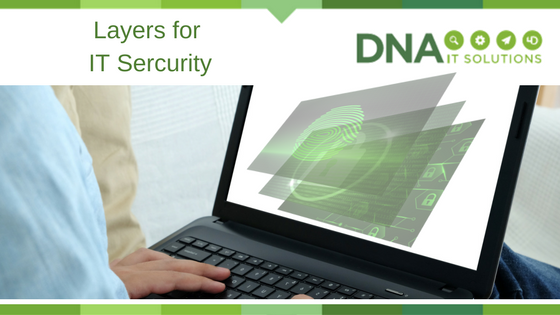
Hackers and cyber-attacks have been around for a long time.  Security needs to evolve as threats become more sophisticated.   What was once the trusted way of protecting the business has become obsolete.  There is no one ‘out of the box’ solution but the combination of the right layers of security could be your saviour.

This whole area of IT is confusing and scary for many business owners so it is only right that you get to see the whole picture.  A good MSP (managed service provider) will have all the tools available to for your situation.  Taking a look at your needs, assessing your risks and discussing your future plans will all be relevant to getting the correct systems in place for you.

Future proof your business and rest easy at night knowing that your systems are being monitored and protected.  The first step is an audit of your hardware and software and then a frank discussion about your businesses future.

Layers rather than a single solution for IT Security

Layers for IT Security DNA IT

A virus is a piece of code which is able to copy itself and infect a system and in turn destroy data.  This corruption can have an extremely detrimental effect on any business.

With each virus getting more sophisticated as they are created, it takes global leading technology to stay ahead of the game.   As the hackers get more access to resources it makes it easier to create an attack.  With users more dependent on IT to run their businesses, the hackers can take advantage of any small vulnerability.

Insider Threat

Your biggest asset could also be the biggest threat to the security of your data.  Your staff might end up doing you huge damage, without any intention and much remorse later.  Many attacks will happen as a result of an email to an internal end user.

An email can be the start of a phishing attack.  Many of the successful ones look very real with less of the wrong spelling, bad grammar and more of the good graphic design.  It’s big business so there is more thought being put into them by the cyber criminals.  They know they can generate big money so attacks are more sophisticated and new ones coming on stream all the time, spreading faster and wider than ever.

Single Solution

There is no single solution for the threat of ransomware.  However, you can work to prevent the attack and having processes in place to recover from an attack.   The solution is a combination of layers of security.

Antivirus – Having antivirus software that is up to date and fit for the task of checking all files against known threats is vital.  Network monitoring will ensure emails are filtered so most malicious ones will never even get to the user.

Patches – As vulnerabilities in software are identified the manufacturer will issue notification for a patch that is required for protection.  Your systems should be updated regularly with the latest ones, sealing the gap where a security leak could happen.

Back up – Regular backups that are stored securely and a full systems backup will form a solid back up plan.  Should an attack occur you need to have a plan in place to have a copy of your data ready to be uploaded so you can keep in business. For critical industries, this could include back up of devices in a real-time situation.  This is part of disaster recovery processes that guarantee business continuity should the worst happen.

Secure systems – Another must have is file encryption.  Use systems that are safe for sharing information, such as Autotask file sync and share.  This allows the team to collaborate securely from multiple locations with familiar programmes such as Word, Excel and PowerPoint.  But without the worry of data being breached.

User training – Staff should be aware of the risks and management should have procedures in place to update skills.  Knowing what to look out for, how to spot something and also what to do if in doubt could divert a catastrophe.

For more information on Autotask as part of your security solution contact the team at DNA IT Solution.   We work with businesses just like you to provide you with the IT infrastructure that allows you to operate effectively in today’s world.

Web Security Threats

Web Security threats DNA IT

There are many security threats facing organisations today.

They are not only the concern of large global companies but can effect even the smallest of businesses.  If you are aware of what may attack your business, then you can put plans in place to ensure you have the right level of cover to protect your systems and data.

Here are some of the most popular types of cyber security threats today:

Malware

Malware is software that is designed to gain access to a computer system in order to damage or disrupt.  Malware can appear on both the computer and the network and can cause significant damage.   Cloud based web security system prevents downloads which will stop the initial infection.  It can also stop the malware connecting to the internet to make more problems.

Spyware

This is software that allows the attacker to spy on the user’s computer activity.  It records activity to learn about the user, stalking it and then uses the information gathered to create some harm. Web security products can reduce the risk of this happening by preventing the users machine from interacting with installed spyware.

Ransomware

Ransomware is software designed to block access to the computer system.  In essence it freezes everything until a ransom is paid.  Many organisations will then pay to get their systems back which makes the hackers become more active.  Web security systems will implement sandboxing to help counteract this threat.  This is where all downloads are analysed off the network to check they are safe before delivering them to the network.

Phishing

Phishing is where a fraudulent email is sent pretending to be from a reputable person or company.  It is sent in the hope that the user will divulge personal and financial details.  Phishing call also be in the form of a website that pretends to be something they are not.  Web security services can check to see what websites or emails are trustworthy and stop the risk at source.

Social engineering

Also known as spear phishing, this is the gathering of personal information either directly or online to later target somebody for financial gain.  By having an additional layer of security on email systems, this can reduce or even eliminate such harmful issues.  Likewise, having security that prevents showing links to harmful websites will give additional protection to the user.

Zero hour Attacks

Also known as zero day attacks, these target well known but unpatched vulnerabilities in operating systems.  Security services will work with other layers of security on end point protection.  Fixes can be rolled out in a matter of hours to help protect against attack.  In addition, systems will detect any breach and block it.

These are only some of the threats to an organisations IT Systems, there are countless other ones that will cause significant damage.

One product that can form part of your security solution is Fusemail.  This is part of our security portfolio at DNA IT Solutions and will provide protection against many threats.  We only work with world leading technology solutions to protect our clients.  Fusemail can be part of your web security service that help protect you, talk to us about it today.

GDPR – Your Challenge, Our Solution

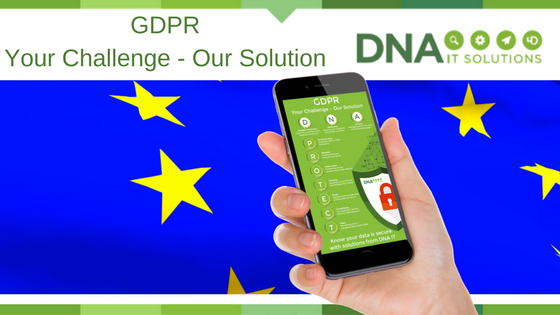
GDPR challenge DNA IT Solutions

With the introduction of GDPR comes a whole new set of challenges that all businesses must face.

Data protection has always been high on the list of priorities for our clients but is now more critical than ever.  With such a variety of clients in many sectors, we must offer a range of solutions that work together to provide the ultimate protection.

Our experience has shown us that we can break down the requirements for data protection into three main sectors – People, Processes and Proper Tools.

Data Protection & People

Your employees can be the most important asset but they can also be a threat to the security of your information.   The majority of data breaches are unintentional but can still cause a lot of serious issues for the organisation.   Lost laptops, files left on trains, files shared by mistake – all human error but unfortunately all too common.

To safe guard against these data losses there are solutions that can be employed to secure data.  The first is file sharing in secure ways using information that is encrypted.  This allows the freedom needed to share projects yet strong control.  With remote working it is important to employ methods to protect mobile devices and manage devices effectively.  In addition, CRM systems that can run in the cloud are secure and accessible to authorised users.


Data Protection & Processes

Having the correct procedures and processes in place will prevent privilege misuse.  Insider threats can be avoided by setting user access levels and having credential authentication ensuring only the right people can access information.  User training is vital when it comes to issues such as cyber security and email phishing.  Monitoring web use can be a useful method of preventing malware and ransomware issues.  Procedures can be put in place by your IT team that will encompass all these methods of protecting company data.  All the while ensuring your processes are compliant with GDPR requirements and allow your team to work effectively.

Data Protection & Proper Tools

Once you have looked at the people and processes element you must then enable them with the proper tools to do the job.  There is not only one solution, protection involves different layers depending on your business.  Detection and prevention work hand in hand to offer protection at all points.  World class antivirus and security software can be employed with hardware you can trust.   Email systems that are tamper proof, allow secure archiving and less chance of phishing will protect your business against attack.

Having an expert team providing you with a security solution to suit your needs, world leading technology and full support will help prevent data breaches and keep your information secure.

The Full Data Protection Picture

When it comes to protecting your business data you need a full solution.  Disaster Recovery planning should be on your agenda to ensure business continuity should the worst happen.  Planning and testing against data loss and suitable backup strategies are vital.  Cloud options that are trustworthy and the provision of dedicated private space where needed are all considerations.

DNA IT Solutions work hard to keep client’s data secure in order to help them to be compliant in GDPR.   We work with expert GDPR consultants to provide a robust solution for organisations of all sizes.  For more information on options for your business get in contact with us today.


Layers of security

Layers of Security DNA IT

Security Alerts

With each passing month there seems to be another story of a company who got hacked, some piece of ransomware that is making the rounds or even news of a colleague whose laptop got infected by a virus.  When you are busy with your business the last thing you should be concerned about is Cyber Security but unfortunately it has become a significant risk.

More places to attack

With IT being the heartbeat of most businesses today, there are more devices and technologies in use than ever.  Even the smallest of offices will have a PC and a laptop.  Add to that the smart phones and tablets that most people seem to use and before long the numbers start to add up.  As we move to the cloud we then concern ourselves with cloud security, network security and sharing information that is not encrypted.

More advanced methods

Cyber-attacks can be lucrative business for hackers and now they are becoming more co-ordinated.  With the ease of communication globally they can be arranged quite easily.  Recent attacks that have been investigated have been found to have been very well thought out and planned well in advance.

Did you know that you can now purchase a kit online that is ready for use and can enable somebody with even basic IT skills to launch an attack?  That means more attackers and an increase in the number of attacks each day.  Sophisticated technology means one keyboard warrior can launch an all-out battle against a victim of choice.

Layers of Security

However, all is not lost so there is no need to give up hope just yet.  As the bad guys get more sophisticated so do the world leaders in IT security.   It is important to know that there is not one single solution that will protect you against everything, rather it will be the layers of security working together that will provide the best protection.

These layers work like a team – they are more effective when all working together and covering all the bases.

  • Proactive – Keeping a watch out for attacks
  • Detection – Knowing and identifying the attack
  • Preventing – Stopping it before it damages
  • Investigating – Checking it out to shield from future attacks
  • Protecting – Protecting your data and your business interests.

In today’s world an organisation needs to look to the protection of the whole business environment.  Having a single centrally managed security approach by amalgamating many vendors will ensure solutions that work together.  Offering consistent protection that helps to provide better security is the key.

At DNA IT Solutions we work with world leading IT Security technologies to provide the best protection for our clients.  Everything from anti-virus software, anti-ransomware methods, secure email systems, mobile protection, perimeter and gate protection.  We also specialise in data loss prevention and end user training for a complete offering.   If you are concerned about the level of protection you have in your organisation maybe it is time to speak with the expert team at DNA IT Solutions.

The Right Security Solution for Mobile Workers

right solution for mobile workers DNA IT

In a previous article we looked at how the modern enterprise meant that workers were now used to working remotely and using mobile technology to enable them to do so.

Using smartphones, laptops and tablets as part of their day to day activities and moving from one to the other with ease.   While this remote working may make life easier for your team, it also leaves them open to high risks.

In that article we looked at the 3 steps needed – 1.Protect users and devices  2.  Protect the Enterprise Network  and 3.  Protect Corporate Data  You can read all about securing mobile part 1 here

What Else is Needed? 

By protecting users and devices, our network and our data, we complete the three key steps outlined already. However, if the solution or solutions we use are typical, they will be complex, piecemeal and not very user friendly.  In order enable the safe path to mobile productivity, organisations need to not only take the 3 steps outlined above, but the solutions they adopt must be comprehensive, simple to deploy and manage and end-user ready. When selecting a solution to protect your users, networks and data, consider the following:

Comprehensive, Simple, End-User Ready!

1) Is the solution comprehensive and integrated? Does it offer all of the critical protections outlined in this paper, or does it leave significant gaps in protection. If it is comprehensive, do all of the parts work as one, or is it a set of individual piece parts that require additional resources?

2) Is the solution simple for you? Is it easy to license, acquire, deploy and manage?  Can you easily measure the effectiveness and compliance delivered by the solution?  Does the solution have a single administrative, reporting and deployment capability?  Are the management processes simple, straight-forward and easy to learn?

3) Is it end-user ready? Can you tailor the solution to meet the needs of your users? Does the solution respect user privacy while still meeting corporate objectives? Does the solution empower users to manage their own issues such as password reset
Mobile use and mobile risk is on the rise.

Employees are no more likely to give up their smartphones and mobile devices and tether themselves back to their desktops than they are to give up streaming music and go back to LPs. Cyber criminals are well aware of these trends. Organisations cannot ignore mobile risk. They must protect their users, devices, networks and data. In order to do this effectively, they need comprehensive solutions that are simple to deploy and manage. And most importantly solutions that are end-user friendly. Only then can organizations reap the productivity benefits of using mobile devices while protecting themselves against the risk.

Sophos Mobile

Sophos Mobile is the EMM solution for businesses that want to spend less time and effort to manage and secure mobile devices. Manage mobile devices with the easy-to-use, web-based, unified Sophos Central admin interface alongside endpoint, network, or server security from Sophos. With its best-in-class data protection, comprehensive security, value-for-money, and flexible management options, Sophos Mobile is the best way to allow the use of mobile devices for work, keeping users productive, business data safe and personal data private.

For more information about incorporating Sophos Mobile into your security solution contact the DNA IT Solutions team.   We work with Sophos tools to help keep our clients protected.


GDPR – Understanding the Data Protection requirements and how to comply

GDPR DNA IT Solutions

The modern office looks a lot different than it did the last time a law was passed on data protection.


We now use more mobile devices in our work and personal life.  Company data is no longer just stored with the walls of an office as we move towards storage in the cloud.

With personal data breaches quite common, this not only puts people at risk of identity theft and financial loss but also puts businesses at risk of losing customer confidence.  Now that GDPR is being introduced next year the consequences will be even more severe with hefty fines.

Sophos recently published a whitepaper on the subject and you can read the full version here.  DNA IT Solutions partner with Sophos to provide an all-round solution to business IT Security and we felt it would be useful to share some of their insights with you.

Why are the changes needed?

It was recognised that there was a need to address the protection of data due to the major technological developments in the past 20 years. GDPR takes the form of a regulation, meaning that it applies directly in every member state in the form in which it was passed. The regulation is intended to strengthen the privacy rights of EU citizens, restore confidence in online activities and better protect customer data by requiring companies to adopt new data protection processes and controls.

Significant elements of reform

GDPR addresses the security of processing data and how organisations need to implement appropriate security measures to protect personal data. It makes specific reference to ‘encryption of personal data’ as one of the means to achieve this.  In regard to encryption technology, this means having a robust key management procedure in addition to encrypting your data. The wider implications are having a sound disaster recovery plan in place.

The consequences

Failure to comply could mean files of up to €20million or 4% of the total turnover whichever is higher. If you don’t put the right technology in place to protect personal data, then you may have to pay – directly to the supervisory authority and indirectly from reputation damage, and loss of goodwill and customer trust. However, companies that encrypt their data protect their customers and themselves.

How Sophos helps you meet the data protection challenge

A solid data protection strategy isn’t built in a day. But consider that 57% of data breaches are due to hackers or malware and 23% of data breaches are caused by unintended disclosure (human error). Securing against these threats is a great place to begin and Sophos recommends three steps to achieve it.

  1. Stop the top causes of data loss

Malicious attacks and accidental loss or theft are two major causes of data breaches. Sophos Central Device Encryption is the easiest way to manage full disk encryption for all your PCs and Mac computers centrally. Full disk encryption is the most basic form of encryption and it’s widely recommended that all computers use it to protect data at rest. It will keep your data secure in the event that a device is lost or stolen.   Sophos Mobile extends similar protection to data on your mobile devices.

Sophos Intercept X works alongside your existing antivirus protection to provide advanced anti-malware, anti-exploit and anti-ransomware protection – keeping you safe from the latest data-stealing attacks.

  1. Stop threats at the door

With todays’ increasingly sophisticated and aggressive malware attacks, having a multi-layered security setup that can stop attacks at every level of your network is essential. XG Firewall protects your network devices by stopping these attacks at the perimeter, before they get to your devices.

Sophos Email Appliance automatically blocks or encrypts sensitive emails and attachments (e.g. PDFs) ensuring your data is always protected, and suspect emails are stopped before they reach your users’ inboxes.

  1. Stop human error

Most of us have sent an email to the wrong person at some point. But when sensitive data is involved that innocent mistake can become a costly fine. The file-level encryption delivered by Sophos SafeGuard means that even when data leaves your devices or network (e.g. email attachment, cloud storage) it stays protected – so even if you suffer a data breach the chance of a fine is greatly reduced.


DNA IT Solutions have already put in place many of the measures that Sophos refer to for our clients.  If you want to find out more about how Sophos can protect your business, please get in touch with us today.

Don’t Take the Bait – Phishing is big business

Phishing DNA IT solutions

In recent times phishing attacks have become more prevalent and sophisticated.

Cyber criminals are learning more refined ways to prey upon people which is resulting in quite a few successful attacks.  In particular, they’ve taken advantage of the malware-as-a-service offerings on the dark web in order to increase the efficiency and volume of attacks. In fact, 91% of cyber attacks and their resulting data breaches now begin with a spear phishing email message.  Now, more than ever there is a need for a multi-layered defence against phishing attacks which combines advanced security technologies with educated, phishing-aware employees.

Sophos shared a white paper recently on this subject and we wanted to share some of their findings with you.  For the full report click here.

What is Phishing?

It’s that email you receive that looks like a request from your bank but when you click on it and enter your login details you are actually handing them over to criminals.  It has even become more than that now.

In 2016, the volume of attacks increased dramatically, fuelled by dark web services such as free phishing kits and phishing-as-a-service. It’s become increasingly simple for even the least technically inclined attacker to leverage advanced malware that’s been produced by someone far more savvy than they are. As such, 2016 has been dubbed the “year of ransomware”.

Improving efficiency and productivity

For the most part, cyber criminals will try extort money from you using ransomware or social engineering, or they’ll steal data and credentials that can be sold via dark web markets.

There has been a rise to more efficient attack distribution methods, with on-demand phishing services, off-the-shelf phishing kits, and new waves of attack types such as Business Email Compromise (BEC) that look to target higher value assets via  social engineering.

Phishing kits are now widely available for download from dark web forums and marketplaces, and give attackers all the tools they need to create profitable phishing attacks: emails, web page code, images, and more.

Attacks-as-a-service

In fact, attackers don’t even need to know how to create malware or send emails anymore. Ransomware-as-a-service allow a user to create an online account and fill out a quick web form, including the starting ransom price and a late payment price for victims. The provider of the service then takes a cut of each ransom paid, with discounts offered if the user is able to translate the malware code into new languages or if the volume of the attack exceeds a certain level

Phishing-as-a-service allows users to pay for phishing attacks to be sent for them, using global botnets to avoid known dodgy IP ranges. Guarantees are even made to only bill users for delivered email messages, much like any legitimate email marketing service.

Spear phishing  is where emails impersonating a specific sender or trusted source are sent to targeted individuals within organisations to try to get them to take certain actions, like sending money to spurious accounts.

Business Email Compromise attacks are so-named because they’re associated with employee email accounts being compromised rather than the sender address being spoofed. This makes attacks much harder to spot by end user.

The fight against phishing

Phishing emails come in all shapes and sizes, and unfortunately, no single product will fully protect your business from phishing attacks. A multi-layered defence against phishing attacks, combining advanced security technologies and educated employees is the only answer

Stop threats at the door

Your first opportunity to defend against phishing attacks and other email-borne threats is strong email and web filtering. Email protection is your watch guard, blocking 99% of unwanted email at the gateway, including malicious attachments, content, and URLs – long before an end user ever sees them. Web filtering is another must-have as a front-line defence, filtering and blocking infected URLs should your users click an email link.

Appropriate education is critical for ensuring that employees know how to spot and deal with these types of email messages. Look for solutions with editable campaign simulations that can be made relevant to your organisation.

Secure your last line of defence

If your click-happy end users inadvertently unleash potent, powerful malware onto your systems, there’s still ample opportunity to stop the damage – and even reverse its effects. Next-generation exploit prevention solutions will identify, analyse, and neutralize the effects of even the most advanced, unseen malware out there, and automatically clean up all trace of infection so you can get on with your day.

Know your business

Make sure your company processes are understood, that you encourage employees to question requests that seem out of character from other employees and senior managers and perhaps most important of all, ensure you have a two-stage approval process for all significant fund transfer requests. All the defences in the world aren’t going to stop an employee from unknowingly sending large payments to a thief without some proper checks and balances in place.

Sophos has powerful technologies that can protect you at each stage of an attack.  For more information visit Sophos or talk to the expert team at DNA IT Solutions, we work with Sophos to help protect clients from cyber attacks.

10 Tell Tale Signs of Phishing from Sophos

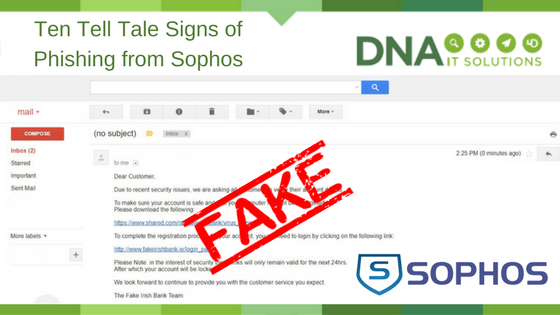
10 tell tale signs of phishing sophos DNA IT

Sophos likes to make security simple for business.  They have provided the top 10  “tells” you can look for to help suss out potential scams.

  1. It just doesn’t look right. Is there something a little off with a particular email message? Does it seem too good to be true? Trust your instincts.
  2. Generic salutations. Instead of directly addressing you, phishing emails often use generic names like “Dear Customer.” This use of impersonal salutations saves the cybercriminals time.
  3. Links to official looking sites asking you to enter sensitive data. These spoofed sites are often very convincing, so be aware of what personal information or confidential data you’re being asked to reveal.
  4. Unexpected emails that use specific information about you. Information like job title, previous employment, or personal interests can be gleaned from social networking sites like LinkedIn and is used to make a phishing email convincing.
  5. Unnerving wording. Thieves often use unnerving wording (such as saying your account has been breached) to trick you into moving fast without thinking and in doing so, revealing information you ordinarily would not.
  6. Poor grammar or spelling. This is often a dead giveaway. Unusual syntax is also a sign that something is wrong.
  7. Sense of urgency. “If you don’t respond within 48 hours, your account will be closed.” By creating a sense of urgency, the thieves hope you’ll make a mistake.
  8. You’ve won the grand prize!” These phishing emails are common, but easy to spot. A similar, trickier variation asks you to complete a survey (thus giving up your personal information) in return for a prize.
  9. “Verify your account.” These messages spoof real emails asking you to verify your account. Always look for signs of phishing, and always question why you’re being asked to verify – there’s a good chance it’s a scam.
  10. Cybersquatting. Often, cybercriminals will purchase and “squat” on website names that are similar to official websites in the hopes that users go to the wrong site e.g. www.google.com vs. www.g00gle.com . Always take a moment to check out the URL before entering your personal information.

For more tips and tools to stop phishing, visit the Sophos website

If you want to discuss your business IT Security you can speak to an expert at DNA IT Solutions.  We partner with Sophos to provide end to send IT Security and support.

October is National Cyber Security Month

Cyber Security Month DNA IT

One of the key concerns for our clients is keeping their business data secure.

Hackers, ransomware, viruses are all words that strike fear due to the threat of untold damage and the negative repercussions that can follow.

European Cyber Security Month (ECSM) is an EU awareness campaign that promotes cyber security among citizens and organisations about the importance of information security and highlighting the simple steps that can be taken to protect their data, whether personal, financial or professional. The main goal being to raise awareness, change behaviour and provide resources to all about how to protect themselves online.

DNA IT Solutions offer a suite of products that can help protect our clients.  We work with world class companies such as Sophos, Watchguard, Fusemail, McAfee and many others to provide layers of security.  However, sometimes it’s an unwitting action from an internal user that causes mayhem.  So we also recommend that users get cyber security smart with some simple tips that may save a company from disaster.

Be aware of online scams

Don’t respond to unsolicited requests for information and certainly be sure of links before you click.  If you are not expecting that email from a contact, if the tone is not right then pick up the phone and call them to see if they sent it to you.  Sometimes you will be targeted by phone for information before being interacted with you online, so verify callers before you give information.  Beware of that ‘super prize win’ because if it looks too good to be true, it usually is.

Be password clever

It’s good practice to have a different password for each account and remember to change your password often.  When it comes to deciding on a password, keep personal information such as your name or pets name out of your password.  Longer passwords are stronger passwords so use a mix of letters, symbols and numbers.  Don’t share your passwords with others and beware of shoulder surfing to steal passwords.

Straightforward advice

Be careful what you browse on a shared device or when you are using an unfamiliar network.  Be careful of what you plug into your computer, ask yourself how reliable it is.  On your own device, keep software up to date for the latest security patches to stay safe.  Remember to back up your valuable information so in the event of a disaster you can get back up and running quickly.

By following this simple advice, you can help in the cyber security fight.  It’s important to ensure you have the right protection that is appropriate to your business and that’s where DNA IT Solutions can help.  We have an expert team that can give you access to the best technology available now.  For more information, get in touch with us today.